Pick your seat at the table
Board members and committees
Read the framework in one picture and the seven principles; then the glossary entries for appetite, tolerance, limit and threshold.
Start here →Chief risk officers and risk teams
Start at the layers, read every component of Frame and Analyze, then the three lenses.
Start here →Internal auditors and supervisors
Every component names its source; start from the twenty-seven sources, then Record, Assure and Report.
Start here →People who build registers and agents
The eight objects, the open formats and the worked example PAY-014, then the schemas themselves.
Start here →The Consolidated Risk Management Framework
The framework borrows its spine from ISO 31000 and adds nothing to it: the six steps of that process become six layers, and Govern is drawn around them, not among them, because governance decides that the cycle runs rather than happening at a point in it. Each layer answers one question, and the components are the units an organisation adopts: each has a code, a name, a specification an auditor can test and a developer can build, and the source it came from.
Three subjects cut through every layer as lenses: artificial intelligence; climate and physical hazards; third parties and the components they supply. Eight objects sit under the layers: the objective, the risk, the control, the scenario, the indicator, the event, the hazard and the assurance activity. The layers are verbs; the objects are nouns.
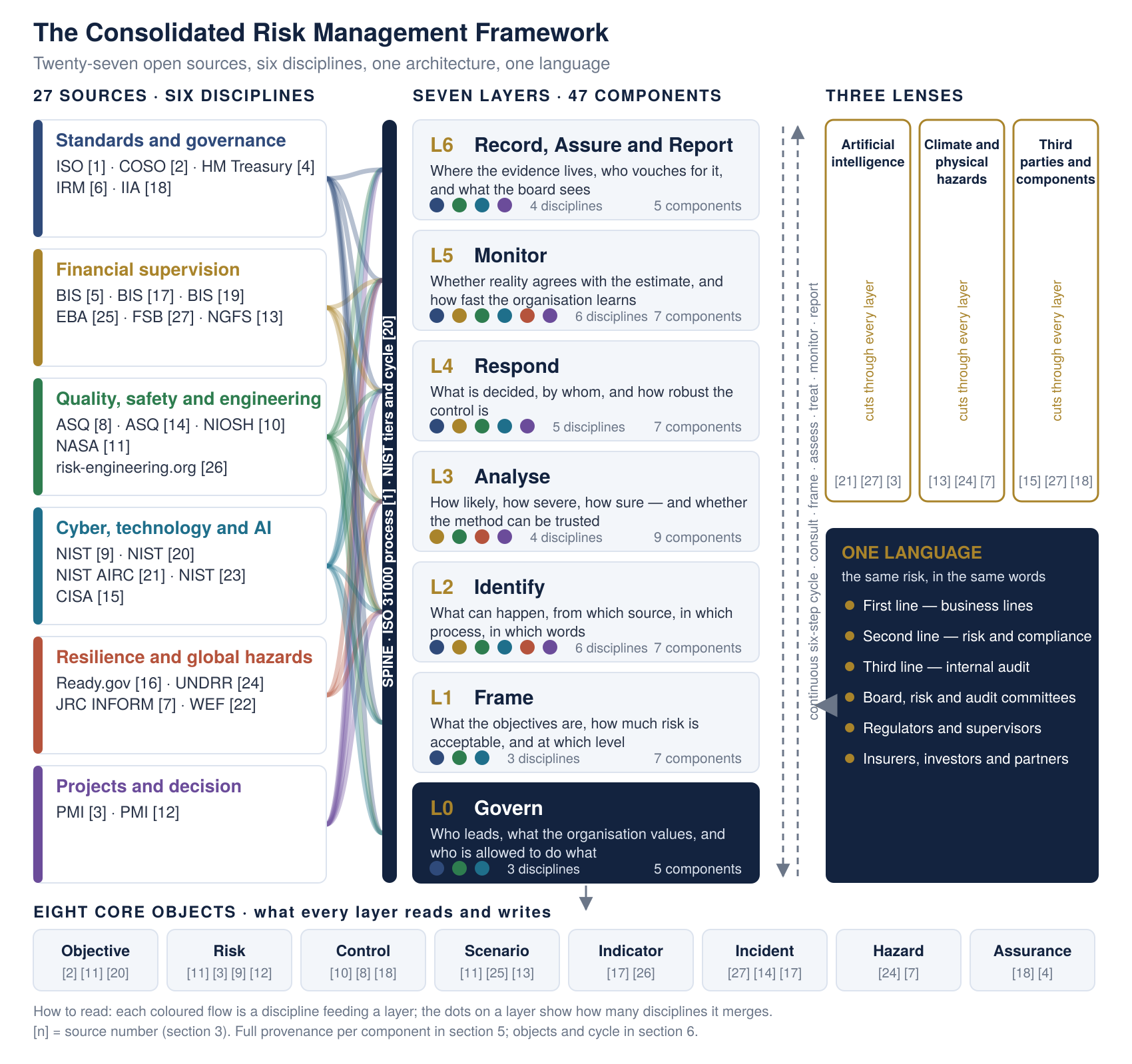
Click a layer to see its components
Where the evidence lives, who vouches for it, and what the board sees5 componentsL5Monitor
Whether reality agrees with the estimate, and how fast the organisation learns7 componentsL4Respond
What is decided, by whom, and how robust the control is7 componentsL3Analyze
How likely, how severe, how sure, and whether the method can be trusted9 componentsL2Identify
What can happen, from which source, in which process, in which words7 componentsL1Frame
What the objectives are, how much risk is acceptable, and at which level7 componentsL0Govern
Who leads, what the organisation values, and who is allowed to do what5 components
One word for each thing
The book keeps one term per idea and records every retired term as an alias, with the source that used it. Appetite, tolerance, limit and threshold are four different things; inherent, expected and measured exposure are three fields, not one called residual. Open the glossary →
Records that can leave the building
Four of the twenty-seven sources publish a format a program can validate. The framework adopts them and proposes schemas for the objects that have none, so that a register, an incident or a hazard means the same thing in every organisation that uses it. What a schema is, in plain words →